Nursery Air Quality Monitor Comparison: Best Choices for Baby’s Room
Nursery Air Quality Monitor Comparison — What Actually Matters
A nursery air quality monitor comparison is only useful if it answers the question that keeps you up at 3 a.m.: “Is the air safe right now, and do I need to do something?” You’re not trying to become an indoor-air scientist — you just want a quiet, readable tool that tells you when to open a window or call the pediatrician, without flooding you with false alarms. This guide compares monitors parents actually use in baby rooms, ranks them by what matters at 2 a.m. (display brightness, false-alarm rate, sensor accuracy for CO2/VOC/PM2.5/humidity, app sanity), and gives you concrete thresholds and safe-placement rules so you can trust the numbers. By the end, you’ll know which sensors to prioritize, how to read a display without waking the room, and exactly when a reading means act-now versus just ventilation.
Medical disclaimer: This article is for general information and does not replace professional medical advice. If your baby shows breathing difficulty, bluish lips, or lethargy, call emergency services immediately — do not wait for monitor readings.
Looking for expert guidance on nursery air quality monitor comparison? This comprehensive guide covers everything you need to know, from understanding the basics to making informed decisions for your family.
Do I need an air quality monitor in the nursery, or is a purifier enough?
A monitor tells you what the air is doing; a purifier cleans it. They’re different tools, and you may need both — but they’re not interchangeable.
What a monitor does: Tracks CO2, VOCs, PM2.5, humidity, or temperature and alerts you when levels shift. Useful for knowing when to ventilate or adjust a humidifier.
What a purifier does: Filters particles or adsorbs gases already in the room. It doesn’t tell you why the air changed.
If budget forces one choice:
- Poor ventilation, stuffy room, frequent colds in household → start with a monitor (CO2 + VOC + humidity).
- Allergies, asthma, high outdoor pollution → start with a purifier, add a monitor later.
The best air quality monitor for a baby room is the one you’ll glance at without waking the baby — readable display, low false-alarm rate, simple thresholds. An expensive sensor array means nothing if you ignore it at 3 a.m.
A nursery air purifier vs monitor decision comes down to information vs. action. You can have both, but know which one answers what’s happening and which one answers what do I do.
Medical disclaimer: This article is for general information and does not replace professional medical advice. If your baby shows breathing difficulty, bluish lips, or lethargy, call emergency services immediately — do not wait for monitor readings.
Which sensors actually matter for a baby’s room — CO2, VOC, PM2.5, humidity?
Not all sensors earn their spot on a nursery nightstand. A baby room humidity and VOC monitor can help, but only if the readings are easy to interpret at 3 a.m. and the thresholds are clear enough to act on without panic.
CO2: what’s normal and when to ventilate
Indoor CO2 above 1,000-1,500 ppm usually means the room needs fresh air, not that the baby is in danger. That range is a ventilation cue, not an oxygen-deprivation diagnosis — a distinction worth knowing so you don’t rush to the ER over a number. Open a window or reduce occupancy, retest in 10-15 minutes, and act again if levels stay high.
VOCs and off-gassing from new nursery items
New mattresses, furniture, and paint can release volatile organic compounds a VOC sensor picks up. A spike after bringing in a new item is common, but most consumer monitors give a total VOC estimate, not a chemical-by-chemical breakdown — so you’ll know something is off-gassing, not exactly what. Ventilation and time are the real fixes; the monitor confirms the trend.
PM2.5 and humidity — real nursery relevance
PM2.5 matters when outdoor pollution, smokers, or frequent cleaning sprays enter the room. Humidity below 30% can dry irritated airways; above 60% raises mold risk. The AAP and general indoor-air guidance point to 30-60% for comfort and mold prevention, not a guaranteed infant-specific protocol.
What to look for in a baby room humidity and VOC monitor
- Readable display you can glance at without turning on a bright light
- Separate CO2, VOC, PM2.5, humidity readings — not a single “air score”
- Low false-alarm rate and simple thresholds you can act on
- Stable sensor life and calibration path for nursery use
If you’re weighing a monitor against a purifier, remember: a purifier cleans the air; a monitor tells you what’s happening. Both have a place, but they answer different questions.
Medical disclaimer: This article is for general information and does not replace professional medical advice. If your baby shows breathing difficulty, bluish lips, or lethargy, call emergency services immediately — do not wait for monitor readings.
Side-by-side comparison of recommended nursery monitors
A nursery air quality monitor comparison should rank models by readability at 2 a.m., not by the number of sensors on the box.
| Model | CO2 | VOC | PM2.5 | Humidity/Temp | Display | App | Typical price |
|---|---|---|---|---|---|---|---|
| Aranet 4 | Yes | No | No | Yes | Large e-ink | Yes | Higher |
| CO2.click | Yes | No | No | Yes | Basic LCD | Limited | Mid |
| Inkbird PTH-9a | No | No | No | Yes | Backlit LCD | Yes | Lower |
| Labtron LAQM-L10 | Yes | Yes | Yes | Yes | LCD | Yes | Lower-mid |
| Amazon Smart Air Quality Monitor | Indirect | Yes | Yes | Yes | Ring light | Alexa | Mid |
Readability first. The Aranet 4’s e-ink stays dim and legible; the Amazon ring gives a quick color cue without waking the room. Inkbird’s backlit LCD is easy to read but can be harsh in a dark nursery.
Sensor accuracy. CO2 sensors vary by unit — expect ±30-50 ppm on quality models, more on budget ones. VOC and PM2.5 readings trend useful rather than lab-precise. Humidity/temp are generally reliable across these brands if placed away from direct airflow.
App sanity. Aranet and Labtron offer historical logs; Amazon ties into Alexa routines. Check whether the app nudges you or floods you with alerts before you buy.
False alarms. Single-sensor CO2 units (Aranet, CO2.click) tend to alarm less than multi-sensor budget boxes that react to cleaning sprays or cooking vapors. A “check ventilation” nudge at 1,000-1,500 ppm CO2 is a cue, not an emergency.
Price reality. Expect roughly: Inkbird < Labtron < Amazon/CO2.click < Aranet 4. The cheapest option that gives you CO2 + humidity + a dim display beats a flashy unit you ignore at 3 a.m.
What this comparison does not do. None of these models are medical devices, and none prevent SIDS. If your baby shows breathing difficulty, bluish lips, or lethargy, call emergency services — do not wait for a reading.
Medical disclaimer: This article is for general information and does not replace professional medical advice. If your baby shows breathing difficulty, bluish lips, or lethargy, call emergency services immediately — do not wait for monitor readings.
Ease-of-use factors that matter at 3 a.m.
The best air quality monitor for a baby room is the one you can read without turning on a bright light and the one that doesn’t spam you with false alarms at 2 a.m. That’s what “air quality monitor features parents need” actually means at 3 a.m. — not the spec sheet, but the display dimming, alert behavior, and whether the app wakes you or just nudges you.
Dark readability. Look for a backlit display that dims to near-black or uses an e-ink-style screen. The Aranet 4 and CO2.click both show large digits at low brightness; the Inkbird PTH-9a and Labtron LAQM-L10 can be harder to read in total dark unless you know the button layout. If you’ll glance at it half-asleep, test the dim mode in-store or check videos — don’t trust the marketing photo.
Notification sanity. Multi-sensor budget boxes (some Amazon Smart, Inkbird, Labtron) tend to push notifications for VOC spikes from cleaning sprays or cooking — which can jolt you awake for a non-issue. Single-sensor CO2 units alarm less often, but confirm the app lets you set a quiet-hours threshold or mute. A “check ventilation” nudge at 1,000–1,500 ppm CO2 is a cue, not an emergency — your monitor should reflect that, not scream.
App reliability. If the app drops offline nightly or requires re-pairing, you’ll stop trusting it. Check recent reviews for “offline,” “bluetooth disconnect,” or “alert delay.” A simple unit that works without the app beats a fancy one that doesn’t.
Power and placement. Plug-in units avoid battery swaps but need a outlet near the crib (not right against it). Battery/battery-plus-plug hybrids give placement flexibility — useful if outlet access is tight by the changing table.
When to seek medical care. A monitor is not a medical device and does not diagnose respiratory conditions or prevent SIDS. If your baby shows breathing difficulty, bluish lips, or lethargy, call emergency services — do not wait for a reading.
Medical disclaimer: This article is for general information and does not replace professional medical advice. If your baby shows breathing difficulty, bluish lips, or lethargy, call emergency services immediately — do not wait for monitor readings.
Safe placement rules so readings are real and baby stays safe
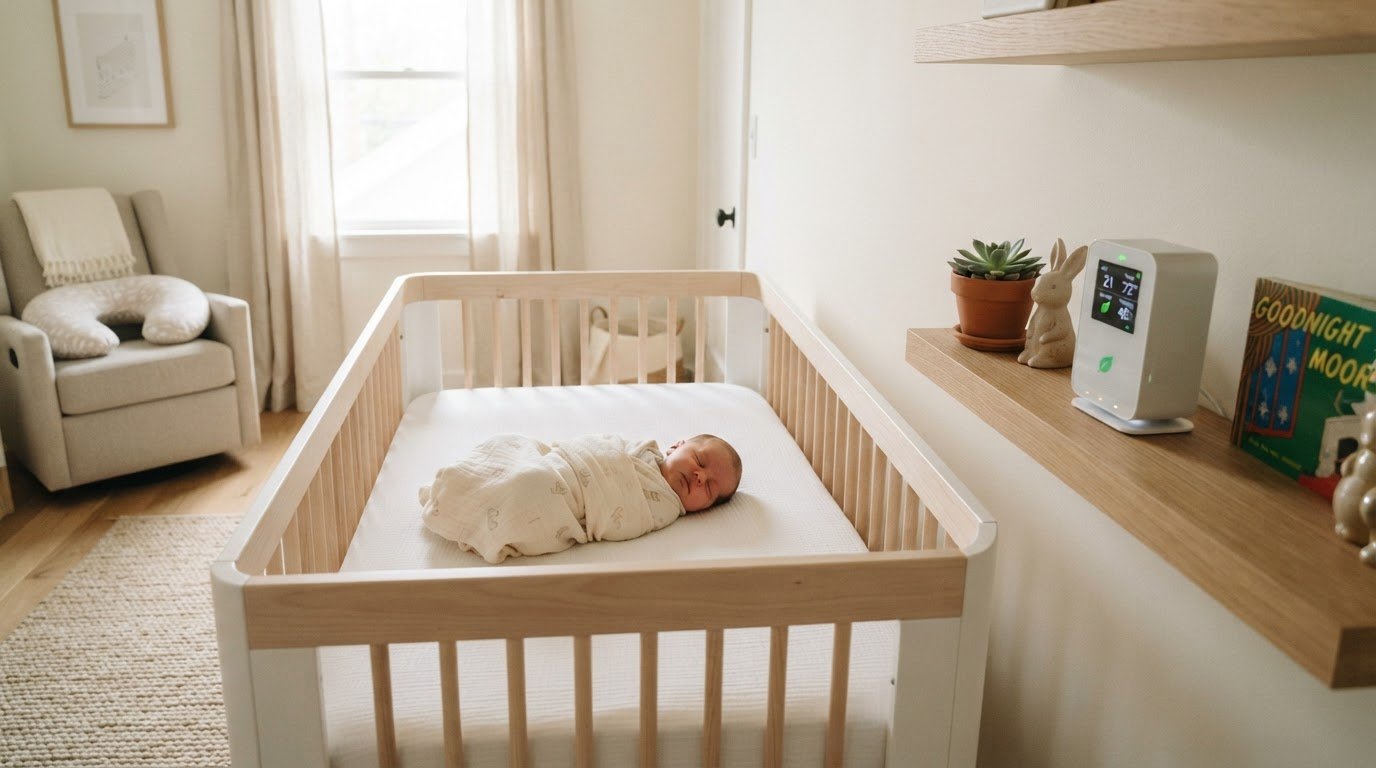
Place the monitor 3–5 feet from the crib, at crib-mattress height or slightly above — never on the crib rail or inside the sleep space. The CPSC’s safe sleep product rules apply to everything in the nursery, including electronics near sleep areas (learn more at Cpsc Products Rules Safe).
What to avoid:
- Direct sunlight, heating vents, or drafty windows — these skew humidity and temperature readings
- Corners or behind furniture where air doesn’t circulate
- Outlets right against the crib; use a plug-in with a slack cord or a battery/hybrid unit
For accurate CO2 and VOC readings: give the monitor 30–60 minutes after closing the nursery door before trusting a baseline. Move it if you repaint, rearrange stuffed animals, or open a window consistently on one side — airflow changes shift what the sensors “see.”
A nursery air quality monitor comparison is only useful if placement is consistent. Pick one spot, note it, and don’t shuffle the unit nightly — trends matter more than single snapshots.
Medical disclaimer: This article is for general information and does not replace professional medical advice. If your baby shows breathing difficulty, bluish lips, or lethargy, call emergency services immediately — do not wait for monitor readings.
Calibration, maintenance, and sensor life in a nursery
Most nursery monitors need zero calibration from parents — they’re pre-calibrated at the factory and stay accurate for 1-2 years if you keep them out of direct sunlight and away from humidity spikes.
What you can DIY:
- Wipe the sensor housing monthly with a dry cloth to clear dust
- Replace CO2 sensors per manufacturer schedule (typically 2-3 years for NDIR sensors)
- Check battery levels quarterly so a low battery doesn’t kill your log during the night
The air quality monitor features parents need include a clear sensor-life indicator and a replacement-cost reminder — not a spec sheet buried in a manual.
If readings drift suddenly after a move or repaint, give the unit 30 minutes in the new spot before trusting it. Factory reset only if the manual says to; otherwise contact support.
Medical disclaimer: This article is for general information and does not replace professional medical advice. If your baby shows breathing difficulty, bluish lips, or lethargy, call emergency services immediately — do not wait for monitor readings.
When to act on a reading vs. ignore it — and when to seek medical care
Act on ventilation cues, not panic. A CO2 reading above 1,000–1,500 ppm means open a window or check airflow — it is not an oxygen emergency. Humidity below 30% or above 60% suggests a humidifier/dehumidifier adjustment. VOC spikes after painting, new furniture, or cleaning products mean ventilation and removal of the source.
When to call your pediatrician (for indoor air quality for newborns especially):
- Any fever in a baby under 3 months (rectal ≥100.4°F / 38°C)
- Persistent cough, wheezing, or fast breathing that doesn’t improve with fresh air
- Skin rash or irritation you suspect links to a new product, plus ongoing symptoms
Call emergency services immediately — do not wait for readings if your baby shows:
- Breathing difficulty, grunting, ribs pulling in with each breath
- Bluish lips, face, or nail beds
- Lethargy, unresponsiveness, or choking
An air quality monitor is not a medical device and does not diagnose respiratory conditions. If you’re unsure whether a reading warrants a call, photograph the display and contact your pediatrician — they’d rather answer a quiet question at 2 a.m. than a crisis at 3 a.m.
Medical disclaimer: This article is for general information and does not replace professional medical advice. If your baby shows breathing difficulty, bluish lips, or lethargy, call emergency services immediately — do not wait for monitor readings.
The bottom line
A monitor and a purifier serve different jobs — you may need both, but they aren’t interchangeable. For most nurseries, CO2 and humidity give you the clearest actionable data; PM2.5 and VOC matter less unless your baby has specific risk factors. Pick for readability at 3 a.m.: dark mode, simple icons, and low false-alarm rates beat extra sensors every time. Place the monitor away from the crib, window, and vent so the numbers are real and baby stays safe.
Know the thresholds that trigger action — ventilate when CO2 sits above 1,000–1,500 ppm, address humidity below 30% or above 60%, and photograph the display if you’re unsure whether to call your pediatrician. But a monitor never replaces clinical judgment: if your baby shows breathing difficulty, bluish lips, or lethargy, call emergency services immediately — do not wait for readings.
You’re already doing the hard part by asking these questions. Trust your instincts, keep the setup simple, and reach out to your pediatrician whenever something feels off — they’d rather answer a quiet question at 2 a.m. than a crisis at 3 a.m.
Medical disclaimer: This article is for general information and does not replace professional medical advice. If your baby shows breathing difficulty, bluish lips, or lethargy, call emergency services immediately — do not wait for monitor readings.
Related Reading on ChildBloom
- Baby swing rocker types comparison
- Stroller cup holders organizer safety
- Car seat travel protective accessories
References and Resources
Frequently asked questions
Is CO2 or PM2.5 the bigger risk in a closed nursery?
In a typical closed nursery, CO2 buildup from poor ventilation usually rises faster and affects sleep quality before PM2.5 becomes dangerous. PM2.5 is the bigger concern if there’s smoking, cooking fumes, or strong cleaning products nearby. A monitor that tracks both lets you respond to each differently — open a window for CO2, change the filter or remove the source for PM2.5.
How accurate are cheap vs. expensive nursery air quality monitors?
Cheap VOC/PM2.5 sensors trend useful but can drift, give false highs near cleaning sprays, and aren’t medical-grade. Mid-range and premium units generally have better calibration and longer sensor life, but no consumer monitor is perfectly precise. Pick one with replaceable sensors and verified zero-point calibration, and treat extreme readings as a cue to check the room rather than panic.
Can a monitor detect off-gassing from new furniture or crib mattresses?
VOC sensors will often spike when off-gassing is heavy, especially in the first days after unpackaging. The reading tells you ventilation is needed, not exactly which chemical is present. If the smell is strong, increase airflow and recheck; persistent high VOCs after airing warrant checking the product’s safety data sheet or contacting the manufacturer.
What humidity level is safest for a newborn’s nursery?
Aim for 40–60% humidity, which helps reduce both dry airways and mold/dust-mite growth. Below 30% can irritate a baby’s nose and skin; above 60% for long stretches can encourage mold. Use a monitor with a reliable humidity sensor and pair it with a humidifier or dehumidifier that has its own independent hygrometer.
Do app-connected monitors wake babies with notifications, and how reliable are they?
Most app alerts are silent or customizable, so they shouldn’t wake the baby unless your phone chimes loudly on the crib side. Reliability depends on Wi-Fi stability and how the app handles missed readings; look for local-bluetooth or low-energy options if your signal is spotty. Test the alert tone and placement during a nap before you need it overnight.
How often do nursery monitors need calibration or sensor replacement?
Calibration frequency varies by brand — some need a zero-point check every few months, others annually. Sensors typically last 1–2 years before drift becomes noticeable, and replacement cost should factor into your purchase. Check the manual for the specific schedule; if it’s unclear, contact the manufacturer before relying on the readings for health decisions.
This FAQ is for general education and does not replace personalized medical advice. If your baby has breathing trouble, persistent cough, blue lips, or a fever in an infant under 3 months, seek care right away.
ChildBloom medical disclaimer: Content is informational only and not a substitute for professional medical evaluation. Always consult your pediatrician for concerns specific to your child.