Allergy-Safe First Birthday Party Foods: Celebration Planning
Allergy-Safe First Birthday Party Foods: Celebration Planning
You’re not overreacting. Planning a first birthday party when food allergies are in the picture means juggling guest lists, decorations, and the very real worry that one bite of the wrong thing could send your child to the ER. Celebration planning with allergies in mind feels like a second job, but it doesn’t have to mean a bare table or a cancelled party.
This section covers what safe foods actually work for a first birthday party when allergies are a concern, how to plan an allergy-friendly toddler party from start to finish, which common allergens hide in birthday foods, choking and supervision risks specific to babies, how to communicate needs to other parents and caterers, and what to have on hand if a reaction happens. By the end you’ll have a practical checklist you can hand to a babysitter or aunt and a short list of low-stress, nut-free birthday snacks that toddlers can actually eat.
One hard rule up front: no honey for any child under 12 months, and whole grapes, popcorn, nuts, and hard candy stay off the table for under-4s. If someone shows signs of anaphylaxis, epinephrine first, then call 911 — no dosing instructions here, because the auto-injector dose must match the child’s weight and prescription. This is general information, not individualized medical advice; run your party plan by your pediatrician or allergist, especially if your child has a known allergy.
When to seek medical care: difficulty breathing, swelling of lips/tongue/face, repeated vomiting, lethargy, or widespread hives after eating — call 911 and use epinephrine if prescribed. For infants under 3 months, any fever 100.4°F/38°C or higher needs same-day pediatric evaluation.
Looking for expert guidance on allergy-safe first birthday party foods? This comprehensive guide covers everything you need to know, from understanding the basics to making informed decisions for your family.
What safe foods work for a first birthday party when allergies are a concern?
Start with plain, single-ingredient foods you can verify yourself: soft fruits, well-cooked proteins, simple starches, and mild dips. This keeps the table safer for a mixed group and makes it easier to spot what triggered a reaction if one occurs.
Fruits: ripe banana slices, mashed avocado, steamed-soft apple or pear pieces, blueberry halves (squashed for under-4s). Flag: citrus and berries can irritate skin but aren’t top-9 allergens.
Proteins: shredded chicken, flaked salmon (check for bones), well-cooked egg pieces, lentil mash. Flag: egg and fish are common allergens; introduce new proteins one at a time.
Starches: soft pasta, small rice-cake pieces, oat-based muffins without whole nuts. Flag: wheat and soy hide in sauces and wraps — check labels.
Dips: hummus (tahini = sesame allergen), yogurt dip (dairy), mashed bean spread. Flag: sesame, dairy, and soy are all common; label each dip separately.
Every item should be soft, mashed, or cut into thin strips no wider than a finger — whole grapes, popcorn, nuts, and hard candy stay off the table for under-4s. If your child has a known allergy, confirm every label with your pediatrician or allergist before the party.
(FACT: AAP/CDC guidance identifies milk, egg, peanut, tree nut, wheat, soy, sesame, fish, shellfish as common food allergens; GENERAL INFORMATION: preparation notes above reflect standard toddler-safety practice.)
See the next section for the full allergy-aware party checklist.
This is general information, not individualized medical advice; consult your pediatrician or allergist for your child’s specific needs.
How do I plan an allergy-friendly toddler party from start to finish?
Start with a simple checklist: map your menu around the safest options, verify every label, and line up an adult-only serving station before guests arrive. A little celebration planning upfront keeps the focus on the birthday kid — not the worry.
Pre-party: menu, sourcing, and label reading
- Decide your menu 1–2 weeks ahead so you have time to test recipes and check labels.
- Store-bought snacks: read the ingredient panel every time, even for familiar brands — formulations change.
- Caterers: ask for the full ingredient list and confirm allergen protocols (separate prep surfaces, utensils).
- Keep a written list of what’s safe for your child and share it with anyone bringing food.
Day-of: serving layout, labels, and supervision zones
- Set up one food station with visible labels for each dish (allergen name on a small card).
- Use adult-only serving utensils — little hands grab and cross-contaminate fast.
- Zone the party: a quiet eating area away from high-traffic toys so you can watch what goes in mouths.
- Remind adults: no sharing of cups, straws, or bites between kids.
Emergency prep: epinephrine, plan, and responsible adult
- If your child carries epinephrine, confirm who brings it, where it stays (not in a hot car), and who is trained to use it.
- Reaction plan: epinephrine first, then call 911 — no dosing instructions here; follow your allergist’s written plan.
- Assign one responsible adult to watch for signs of reaction and know the exit route.
(FACT: AAP/CDC identifies milk, egg, peanut, tree nut, wheat, soy, sesame, fish, shellfish as common food allergens; EDITORIAL GUIDANCE: the checklist above reflects standard allergy-aware party practice.)
See the next section for festive food ideas that skip the top allergens.
This is general information, not individualized medical advice; consult your pediatrician or allergist for your child’s specific needs.
Which common allergens should I watch for in birthday party foods?
The nine major allergens — milk, egg, peanut, tree nut, wheat, soy, sesame, fish, and shellfish — show up in places you’d never suspect at a typical party spread. (FACT: AAP/CDC identifies these as the most common food allergens.)
Where they hide:
- Milk: butter-based frostings, “dairy-free” creamer swaps, hidden whey/casein in cake mixes
- Egg: wash on decorative cookies, macarons, some marshmallows
- Wheat: pretzels, cereal bars, flour-dusted snack bowls
- Soy: soybean oil in fried items, soy lecithin in chocolate
- Sesame: hamburger buns, granola bars, hummus
- Fish/shellfish: Caesar dressing, seafood pasta salads
For nut-free birthday snacks, read every label — “may contain” warnings vary by brand and batch. Cross-contamination matters too: shared tongs at a cheese board can carry trace peanut from a neighboring dish.
EDITORIAL GUIDANCE: lay out foods separately, label what’s in each dish, and keep your child’s safe plate clearly marked. When in doubt, skip it — a missed snack is safer than a missed reaction.
This is general information, not individualized medical advice; consult your pediatrician or allergist for your child’s specific needs.
What choking and supervision risks exist at a baby’s first birthday celebration?
Choking hazards for toddlers are real at a first birthday party — the same foods that look festive on a table can block a small airway in seconds. Whole grapes, popcorn, nuts, hard candy, and raw chunks of apple or carrot are the usual culprits. A toddler’s chewing and grinding skills are still immature, and a quick grab-and-pop approach to party food doesn’t leave much time for safe swallowing.
At what age can toddlers safely eat typical party foods like cupcakes and popcorn?
- Popcorn: Not before age 4. The kernels and hulls are a classic aspiration risk — no “just a few pieces” shortcut.
- Nuts and seeds: Whole nuts and chunky nut butters are a no-go under 4; thin spreads of sunflower seed butter can work earlier if your pediatrician clears it.
- Cupcakes/frosting: Soft crumbs are usually okay around 12 months if your child is chewing well, but watch for large frosting globs or hard sprinkles.
- Grapes, cherry tomatoes, hot dogs: Slice lengthwise into quarters until at least age 5 — round shapes seal a airway perfectly.
Supervision rules: One adult per toddler at the food table, no running with food, no whole nuts or popcorn within reach, and a clear “done eating” spot away from the play area. Keep your child’s epinephrine auto-injector accessible and know the signs of anaphylaxis — swelling, trouble breathing, repeated vomiting — then epinephrine first, 911 second.
This is general information, not individualized medical advice; consult your pediatrician or allergist for your child’s specific needs.
How do I communicate allergy needs to other parents and caterers?
Start with the invite: “We’re keeping the menu nut-free and egg-free for little guests — please let us know any allergies when you RSVP.” That one sentence sets expectations before anyone shops.
For texts closer to the date, keep it specific: “Heads up — no peanut butter snacks, please. We’ve got toddler-safe alternatives covered.” Short, direct, no apology needed.
With a caterer, ask these questions before you book:
- Can you prepare a separate, allergen-free plate without cross-contact?
- What’s in the [item] — specifically milk, egg, wheat, soy, sesame, fish, shellfish?
- Can you label each dish with ingredients?
Label everything at the party table, even store-bought items. A simple tent card (“contains: dairy”) helps adults supervise correctly.
When to seek care: If a guest child shows swelling, trouble breathing, or repeated vomiting, give epinephrine first, then call 911.
This is general information, not individualized medical advice; consult your pediatrician or allergist for your child’s specific needs.
Can I still make the party festive without common allergen foods?
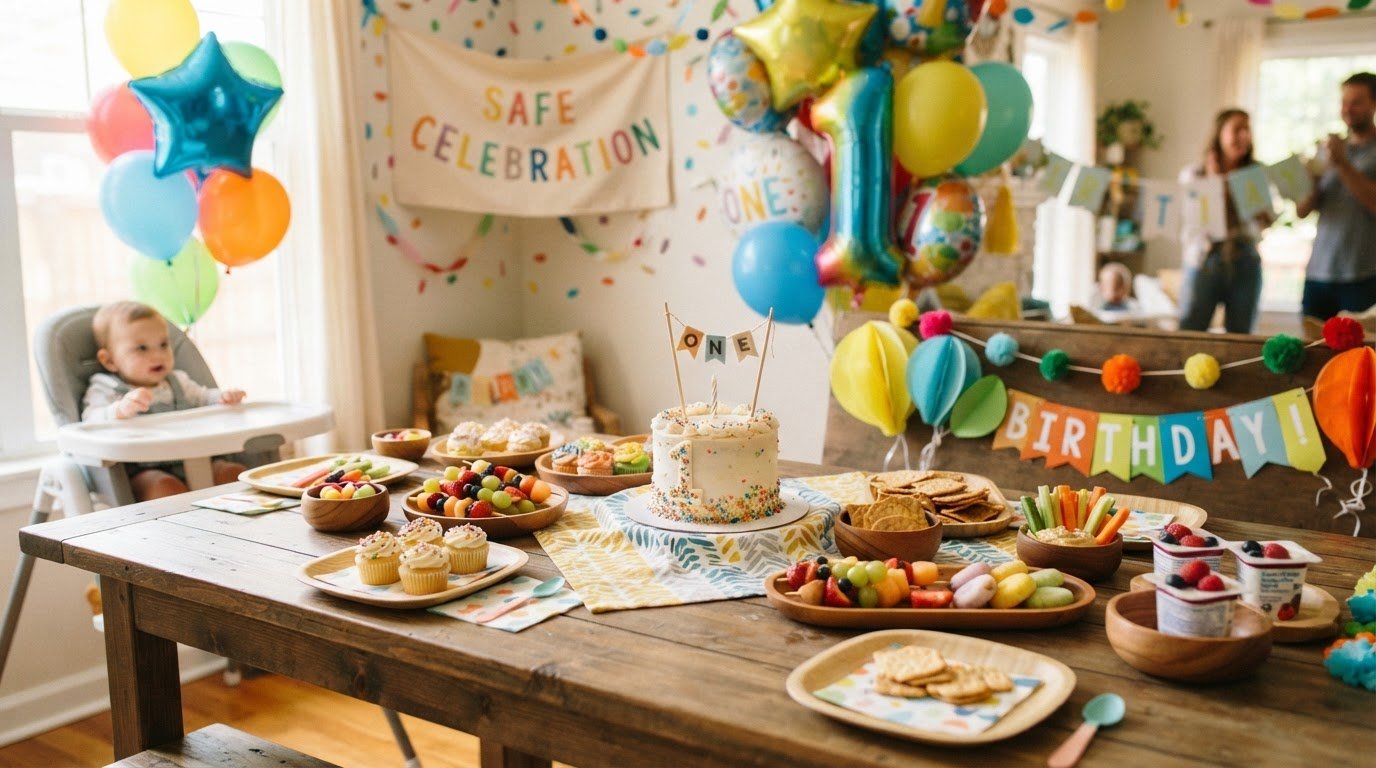
Yes — the party’s magic comes from the kid, not the cupcake. A first birthday is mostly about noise, photos, and tiny humans face-planting into cake. Decorations, a silly hat parade, and a “cake smash” with a safe recipe carry the festive load just fine.
Baby-safe celebration foods that still feel special:
- Single-ingredient finger foods: roasted sweet-potato wedges, banana “sushi” (banana + oat-puff coating), avocado halves.
- Allergen-free cupcakes: oat-flour, sunflower-butter base — check labels for hidden sesame and coconut (tree-nut cross-contact risk).
- Fruit skewers with soft blueberries and melon (cut lengthwise, not round coins — see choking section).
Keep the vibe simple: one safe dessert option, labels on everything, and a separate “adult treat” table so no one feels deprived.
Build a feeding plan that protects your milk supply and sleep → Build Feeding Milk Night.
When to seek care: Swelling, trouble breathing, or repeated vomiting after eating → epinephrine first, then 911.
This is general information, not individualized medical advice; consult your pediatrician or allergist for your child’s specific needs.
What should I have on hand in case of an allergic reaction at the party?
Have an epinephrine auto-injector ready, a phone to call 911, and a second adult assigned to stay with the child at all times. If you suspect anaphylaxis, give epinephrine first — then call 911. Do not wait to see if symptoms improve on their own.
When to seek medical care:
- Anaphylaxis signs: swelling of face/lips/tongue, trouble breathing or wheezing, repeated vomiting, sudden lethargy, or widespread hives.
- Any of these in a child under 3 months → treat as urgent, epinephrine then 911.
- If symptoms resolve after epinephrine, still go to the ER — rebound reactions happen.
Party-day prep checklist:
- Confirm which guest has a diagnosed allergy and which auto-injector they bring (label it with name/expiry).
- Designate one adult who knows the step-by-step: inject, call 911, note time, lay child flat if breathing is okay (or on side if vomiting).
- Keep a written allergy card by the food table so helpers know what not to offer.
- Store the auto-injector at room temperature, out of direct sun.
If you haven’t made an allergy action plan with your pediatrician or allergist yet, do that before the party. General information — not a substitute for individualized guidance.
This is general information, not individualized medical advice; consult your pediatrician or allergist for your child’s specific needs.
After Bonding First Nicu · After Baby Bonding Delivery
The bottom line
Pick soft, low-allergen foods and cut them for a 1-year-old’s chewing stage. Label every dish and keep adult supervision at the food table. Have epinephrine accessible and a written reaction plan before guests arrive. Communicate needs early with simple scripts for invites and caterers. Know the anaphylaxis signs and the epinephrine-first-then-911 sequence.
If your child has a known allergy, confirm the plan with your pediatrician or allergist before the party — this is general information, not individualized medical advice.
This is general information, not individualized medical advice; consult your pediatrician or allergist for your child’s specific needs.
Related Reading on ChildBloom
- Baby anaphylaxis: signs, causes & emergency steps
- Introducing new foods to toddlers
- Bottle refusal teething quick fixes
References and Resources
- Food Allergy Research & Education
- American Academy of Pediatrics
- Centers for Disease Control and Prevention
Frequently asked questions
Are store-bought birthday snacks reliably allergen-free?
Not necessarily — “allergen-free” claims on packaged snacks vary by brand and facility, so check the label every time even for familiar products. Look for explicit allergen statements and “may contain” warnings rather than relying on marketing language. When in doubt, choose treats from brands with dedicated allergen protocols or bring your own verified options for the birthday child.
How do I label foods so parents know what’s safe?
Use simple tent cards or stickers listing the food name and its top allergens (milk, egg, wheat, soy, peanut, tree nut, fish, shellfish). Keep labels visible at each dish and note any cross-contact risks, such as “served on same tray as nuts.” Clear labeling helps other parents relax and lets kids with allergies self-identify safe choices.
What non-food party favor ideas work for allergy-aware celebrations?
Stickers, bubbles, sidewalk chalk, small toys, or activity kits let every child enjoy a favor without allergen worry. Avoid food treats in the favor bags unless you’ve confirmed each item is safe for the guests. A small note on the bag listing contents helps parents approve it before their child opens it.
How far in advance should I plan an allergy-safe birthday menu?
Start at least 2-3 weeks ahead so you can test recipes, check labels, and confirm safe options with other parents or the venue. Earlier planning is better if you’re catering, renting equipment, or coordinating with a venue kitchen. Build in a backup plan — a simple safe meal the child already eats — in case something falls through.
Can I still make the party festive without common allergen foods?
Yes — focus on decorations, music, games, and a safe cake or cupcake the birthday child can enjoy. Colorful plates, banners, and activity stations create the celebration vibe without relying on allergen-heavy treats. A photo of the child with their safe food often becomes the keepsake, not the specific brand of cupcake.
What should I have on hand in case of an allergic reaction at the party?
Keep the child’s prescribed epinephrine auto-injector accessible, know how to use it, and have a charged phone to call emergency services. Ask parents in advance which kids have allergies and what their action plan is. Watch for hives, swelling, vomiting, breathing trouble, or sudden lethargy, and act fast — don’t wait to see if symptoms improve.
This FAQ is for general information and does not replace personalized medical advice. If your child has a known allergy, work with your pediatrician or allergist on a specific party plan and emergency protocol.