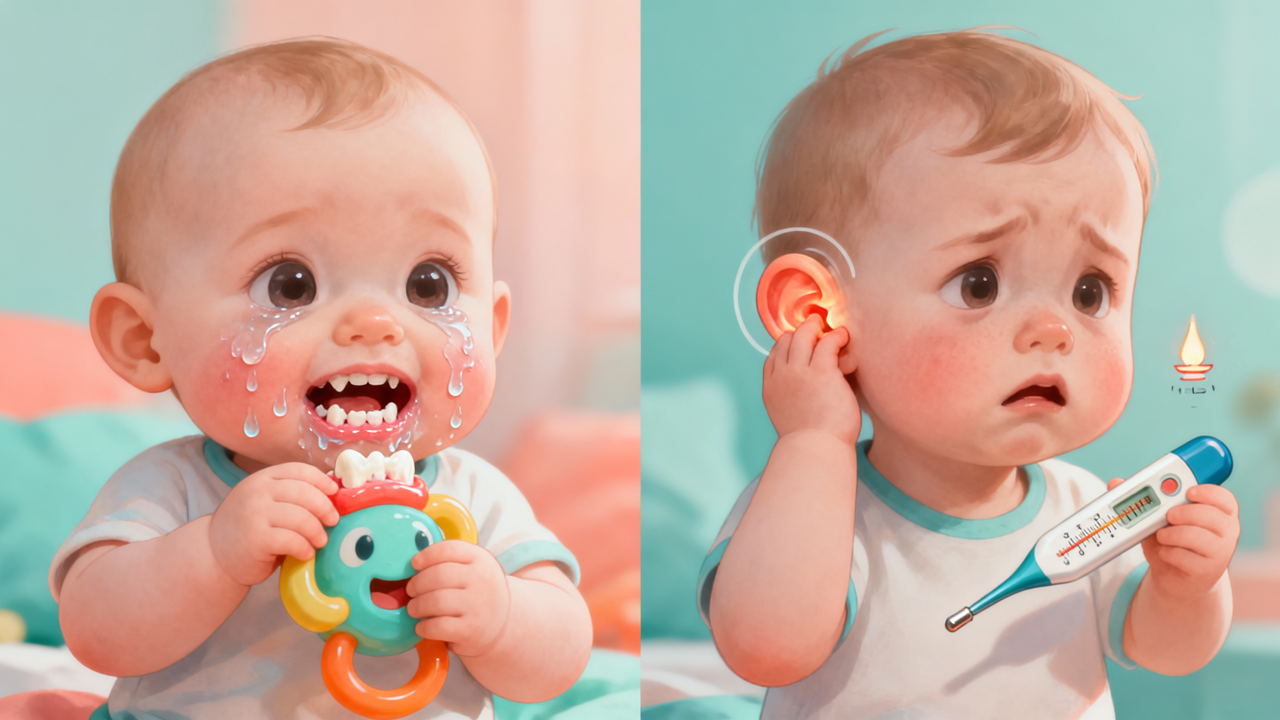
Teething vs. Ear Infection: Symptoms and Next Steps
Medically reviewed by Dr. Ahmad Raza, MD (Pediatrics) — ChildBloom Medical Review Panel. Last updated: August 4, 2026.
Editorial & affiliate disclosure: our guidance is written and reviewed by clinicians. ChildBloom may earn a commission from qualifying purchases made through links on this page, which never changes what our pediatric reviewers recommend.
Looking for clear answers about teething vs ear infection? This pediatrician-reviewed guide covers what matters, what to skip, the safety checks that count, and exactly when to involve your doctor — based on current AAP, CDC and CPSC guidance on teething vs ear infection.
Quick pediatrician summary: teething vs ear infection
Short answer: A pediatrician explains teething vs ear infection: what is normal, the real risks, red flags to watch for and exactly when to call your doctor.
Every parent knows the drill. Your baby is fussy, pulling at their ears, maybe running a low-grade fever. Your mind races between two possibilities: teething or an ear infection. And here’s the thing — the symptoms genuinely overlap, which is exactly why this question shows up in pediatrician offices thousands of times every week.
After reviewing the latest guidance from the American Academy of Pediatrics (AAP) and the CDC, I put together this guide to help you sort through the confusion. You’ll learn the specific symptoms that point toward teething, the red flags that suggest an ear infection, and the exact moments when a doctor’s visit becomes non-negotiable.
This isn’t guesswork. It’s a structured, symptom-by-symptom breakdown designed for parents who want clear answers at 2 a.m. — because that’s usually when you need them.
Quick Answer: Teething vs Ear Infection
Teething vs ear infection — what’s the fastest way to tell? Teething typically causes mild fussiness, drooling, gum swelling, and a desire to chew — but not a fever above 100.4°F (38°C) or severe ear pain. An ear infection usually involves a higher fever (above 101°F / 38.3°C), significant ear pain, trouble sleeping flat, and sometimes fluid drainage from the ear. If symptoms last more than 48 hours or your child appears genuinely distressed, contact your pediatrician.
Key Takeaways
- Fever is the clearest signal. Teething may raise temperature slightly, but a fever above 100.4°F almost always points to infection — not teeth.
- Ear pulling isn’t definitive. Babies tug their ears when teething and when they have an ear infection. Look for additional symptoms before deciding.
- Duration matters. Teething discomfort comes in waves and resolves as the tooth breaks through. Ear infection pain tends to worsen over 24–48 hours.
1. Common Teething Symptoms — What to Expect
Teething typically begins between 4 and 7 months of age, though some babies start earlier and others later. The process continues until around age 3, when most children have a full set of 20 primary teeth. Each tooth eruption can trigger a cluster of symptoms that last anywhere from a few days to a week.
Understanding what’s normal during teething helps you rule out other conditions — including ear infections. Here are the most commonly reported symptoms, based on AAP guidance and parental reports:
Mild and Common Signs
- Excessive drooling — You’ll notice wet clothes, chin rash, and constant wiping. Drool increases significantly as teeth push through the gums.
- Gum swelling and sensitivity — The area where the tooth is emerging looks puffy, red, and feels firm to the touch.
- Increased chewing behavior — Your baby wants to gnaw on everything: fingers, toys, bottle nipples, even their own fist.
- Mild irritability — Especially around feeding times. Sucking increases pressure on swollen gums, which can be uncomfortable.
- Disrupted sleep — Babies may wake more frequently at night. Pain perception often increases when there are fewer distractions.
- Cheek flushing — One cheek may appear slightly redder or warmer than usual, on the side where the tooth is erupting.
- Slight temperature increase — Some studies note a marginal rise in body temperature during teething, but it should stay below 100.4°F (38°C).
What Teething Does NOT Cause
It’s important to know the limits of what teething explains. According to the AAP and multiple peer-reviewed studies, teething does not cause:
- High fever (above 100.4°F / 38°C)
- Diarrhea or loose stools
- Full-body rashes
- Vomiting
- Respiratory symptoms (cough, runny nose, congestion)
2. Ear Infection Symptoms — When It’s More Than Teeth
Ear infections — medically known as acute otitis media — are among the most common childhood infections. The CDC reports that roughly 5 out of 6 children will have at least one ear infection before their third birthday. Because the Eustachian tubes in young children are shorter and more horizontal, fluid traps more easily behind the eardrum, creating an ideal environment for bacteria and viruses.
Here are the symptoms to watch for:
Primary Symptoms
- Ear pain (otalgia) — Older children can tell you their ear hurts. Babies may cry inconsolably, especially when lying down, because pressure on the infected ear increases.
- Fever — Typically 101°F (38.3°C) or higher. A fever is one of the most reliable indicators that something beyond teething is going on.
- Ear tugging or pulling — While not diagnostic on its own, persistent ear pulling combined with other symptoms strongly suggests an ear infection.
- Trouble sleeping — Lying flat increases pressure in the middle ear. Children with ear infections often sleep worse than usual and may resist naps.
- Fluid drainage — If the eardrum ruptures (which happens in some cases), you may see fluid — yellow, white, or slightly bloody — draining from the ear canal.
Secondary and Behavioral Signs
- Decreased appetite — The sucking and swallowing motion changes pressure in the middle ear, which can be painful during an infection.
- Increased fussiness or crying — More intense and harder to soothe than typical teething crankiness.
- Difficulty hearing or responding to sounds — Fluid behind the eardrum muffles sound. You may notice your child doesn’t respond when you call their name.
- Balance issues — The inner ear helps control balance. Some children become unsteady or seem unusually clumsy.
- Follows a cold or upper respiratory infection — Most ear infections develop during or shortly after a cold, flu, or sinus infection.
3. The 7 Key Differences Between Teething and Ear Infections
When you’re up at midnight trying to figure out what’s wrong with your baby, here are the seven most telling differences between teething and an ear infection. Each one gives you a clearer picture of what’s actually happening.
Difference 1: Fever Level
Teething may cause a slight rise in temperature — perhaps 99–100.3°F. An ear infection typically pushes the temperature to 101°F or higher. If the thermometer reads above 100.4°F, don’t assume it’s just teeth.
Difference 2: Symptom Duration
Teething discomfort usually comes in waves, lasting 3–5 days per tooth. Ear infection pain tends to worsen steadily over 24–48 hours and doesn’t resolve on its own in that timeframe.
Difference 3: Response to Pain Relief
Teething pain responds well to gum massage, cold teething toys, and weight-appropriate doses of acetaminophen or ibuprofen. Ear infection pain may temporarily improve with medication but returns quickly because the underlying inflammation persists.
Difference 4: Presence of Cold Symptoms
Teething doesn’t cause a runny nose, cough, or congestion. If your baby has these symptoms alongside ear discomfort, an infection following a cold is far more likely.
Difference 5: Pain When Lying Down
Both conditions can disrupt sleep. However, an infant with an ear infection often screams or arches their back when placed flat, because the position increases pressure in the middle ear. A teething baby may be restless but usually doesn’t show this acute positional pain.
Difference 6: Visual Evidence
With teething, you can often see — and feel — the swollen gum or emerging tooth. With an ear infection, there’s nothing visible externally. Only an otoscope examination by a healthcare provider can confirm fluid or inflammation behind the eardrum.
Difference 7: Eating Behavior
A teething baby might refuse solid foods but usually continues nursing or bottle-feeding. A baby with an ear infection often resists sucking altogether, because the swallowing motion creates painful pressure changes in the ear.
4. Side-by-Side Comparison Table
| Symptom / Sign | Teething | Ear Infection |
| Fever | Mild or none (under 100.4°F / 38°C) | Moderate to high (101°F+ / 38.3°C+) |
| Ear pulling | Occasional, due to referred gum pain | Frequent, with signs of acute ear pain |
| Drooling | Heavy, constant | Normal or slightly increased |
| Gum changes | Swollen, red, firm gums visible | No visible gum changes |
| Cold symptoms | None | Often follows a cold (runny nose, cough) |
| Pain lying down | Mild restlessness | Significant pain, crying when flat |
| Eating changes | May refuse solids; continues bottles | May refuse bottles/nursing due to ear pressure |
| Fluid from ear | Never | Possible if eardrum ruptures |
| Duration | 3–5 days per tooth, then improves | Worsens over 24–48 hours without treatment |
| Chewing desire | Strong — wants to gnaw on objects | No particular interest in chewing |
| Hearing changes | None | Possible muffled hearing from fluid |
| Age range | 4 months to ~3 years | 6 months to 3 years (peak 6–24 months) |
5. When to See a Doctor — Red Flags You Shouldn’t Ignore
Most ear infections resolve with time and supportive care, but certain situations demand prompt medical attention. The AAP recommends contacting your pediatrician if any of the following apply:
- Your baby is under 6 months old — Younger infants need closer monitoring because infections can progress faster.
- Fever reaches 102.2°F (39°C) or higher — This is a strong indicator of bacterial infection requiring evaluation.
- Symptoms last more than 48–72 hours — If the pain and fever aren’t improving after 2–3 days, an exam is warranted.
- Fluid or pus drains from the ear — This suggests a ruptured eardrum and needs professional assessment.
- Your child seems unusually lethargic — Extreme drowsiness, difficulty waking, or unresponsiveness are emergency signs.
- Repeated ear infections — Three or more infections in six months may warrant a referral to an ENT specialist.
- You’re unsure — When you can’t determine whether it’s teething or an ear infection, a quick otoscope exam at the pediatrician’s office settles the question in minutes.
6. Proven Relief Methods for Both Conditions
Teething Relief That Actually Works
- Cold teething toys — Chill (don’t freeze) a solid rubber teether in the refrigerator. The coolness numbs swollen gums gently. Avoid gel-filled teethers, which can break.
- Gum massage — Wash your hands, then apply gentle, firm pressure to the swollen gum with your fingertip for 1–2 minutes. Many parents report near-immediate calming.
- Cold, wet washcloth — Soak a clean washcloth in cold water, wring it out, and let your baby chew on it. The texture and temperature provide dual relief.
- Weight-appropriate pain medication — Acetaminophen (Tylenol) or ibuprofen (Motrin/Advil) can be given at the correct dose for your baby’s weight. Ibuprofen is approved for babies 6 months and older. Always consult your pediatrician for dosage.
- Extra comfort and holding — Sometimes a teething baby just needs more physical contact. Skin-to-skin contact, babywearing, and extra nursing sessions can all help.
Ear Infection Comfort Strategies
- Keep the head elevated — Prop the mattress slightly or hold your child upright. This reduces middle ear pressure and eases pain.
- Warm compress — Apply a warm (not hot) washcloth to the affected ear for 10–15 minutes. The warmth can reduce pain perception.
- Pain medication — Acetaminophen or ibuprofen at the correct weight-based dose helps manage fever and pain. These are the first-line recommendations from the AAP.
- Hydration — Encourage frequent small feeds. Swallowing helps open the Eustachian tubes and drain fluid. If nursing is painful, try offering smaller, more frequent feeds.
- Follow your pediatrician’s plan — Some ear infections require antibiotics. If prescribed, complete the full course even if your child seems better. For mild cases, the AAP supports a “watchful waiting” approach for 48–72 hours in children over 6 months.
7. Common Myths vs. Facts
Myth: “Teething causes high fever, diarrhea, and colds.”
Fact: Research published in Pediatrics found only a marginal temperature increase during teething — never above 100.4°F. High fever, diarrhea, and cold symptoms always indicate a separate illness that deserves its own diagnosis.
Myth: “Ear pulling always means an ear infection.”
Fact: Babies explore their bodies. Ear pulling is also a self-soothing behavior and a teething response. It only suggests infection when combined with fever, recent cold, and increasing distress.
Myth: “All ear infections need antibiotics.”
Fact: The AAP recommends watchful waiting for 48–72 hours in children over 6 months with mild symptoms. Many ear infections are viral and resolve without antibiotics. Overuse contributes to antibiotic resistance.
Myth: “Amber teething necklaces are safe and effective.”
Fact: The AAP and FDA warn against amber necklaces due to strangulation and choking risks. No clinical evidence supports succinic acid absorption through the skin as a pain reliever.
8. Expert Tips from Pediatricians
- Trust the thermometer. A digital rectal thermometer gives the most accurate reading for infants under 3 months. For older babies, a temporal artery thermometer is reliable. When in doubt, take the temperature — it’s the single fastest way to narrow down your possibilities.
- Look at the timeline. If your 8-month-old was perfectly fine three days ago and suddenly has a runny nose, fever, and ear pulling, that’s almost certainly not teething. Teething doesn’t cause cold symptoms. An infection is the logical explanation.
- Take a photo of the gums. If you’re unsure whether gums are swollen, snap a picture and compare it to baseline photos. Red, bulging gum tissue where no tooth has emerged yet is a clear teething sign.
- Try the jaw test. Gently press on your baby’s jaw just below the ear. If they cry in sharp pain, it could be the TMJ area referring pain from an ear infection. Teething pain is more localized to the gums.
- Keep a symptom diary. Track what you observe — temperature, feeding amounts, sleep quality, and behavior — for 24–48 hours. This information is invaluable for your pediatrician and helps distinguish between the fluctuating pattern of teething and the escalating pattern of an infection.
9. Important Safety Warnings
Never give aspirin to a child under 18 years old — it’s linked to Reye’s syndrome, a rare but life-threatening condition. Avoid benzocaine-containing teething gels (like Orajel) for children under 2, as the FDA warns they can cause methemoglobinemia, a serious blood disorder. Homeopathic teething tablets containing belladonna have also been flagged by the FDA for inconsistent dosing and potential toxicity. When it comes to pain relief in babies, stick to acetaminophen or ibuprofen at the correct weight-based dose, approved by your pediatrician.
Frequently Asked Questions
Can teething cause an ear infection?
No. Teething does not cause ear infections. They are separate conditions that happen to share some overlapping symptoms — like fussiness and ear tugging. Ear infections are caused by bacterial or viral infections that trap fluid behind the eardrum, often following a cold or respiratory illness.
How can I tell if my 6-month-old has an ear infection or is just teething?
Check the fever first. A temperature above 100.4°F (38°C) is rarely caused by teething. Next, look for cold symptoms — runny nose, cough, or congestion — which point toward an infection rather than teething. Also observe whether your baby refuses the bottle or breast, which is more common with ear pain. If you’re unsure, your pediatrician can confirm with a quick otoscope exam.
What does an ear infection look like in a baby who can’t talk?
Babies can’t tell you their ear hurts, so watch for behavioral cues: persistent ear pulling, crying that worsens when lying down, fever, trouble sleeping, decreased appetite, and unusual irritability. If your baby recently had a cold and now seems uncomfortable, an ear infection is a strong possibility. A healthcare provider can confirm the diagnosis by examining the eardrum.
Is it normal for teething to cause a 101°F fever?
No. A 2011 study published in Pediatrics reviewed multiple studies and found that teething may slightly raise oral temperature, but it does not cause a true fever (defined as 100.4°F / 38°C or higher rectally). A fever of 101°F or above in a teething-age infant should always be evaluated as a potential infection.
How long does an ear infection last in babies?
With treatment (if antibiotics are prescribed), symptoms typically improve within 48–72 hours. Without antibiotics — in cases where the infection is viral and the AAP’s watchful waiting approach is used — mild ear infections can resolve on their own in 7–10 days. Fluid behind the eardrum may linger for weeks after the infection clears, which is normal and doesn’t always require additional treatment.
Can I give my baby Tylenol for teething and ear infection pain?
Yes. Acetaminophen (Tylenol) is considered safe for babies of all ages when given at the correct weight-based dose. Ibuprofen (Motrin/Advil) is approved for babies 6 months and older. Both can help with teething discomfort and ear infection pain. Always follow your pediatrician’s dosage guidance and never exceed the recommended amount.
Why does my baby pull their ears during teething?
The gums and ears share nerve pathways (particularly the trigeminal nerve). When gums are inflamed during teething, the pain can radiate to the ear area — this is called “referred pain.” Your baby may pull or tug at their ear because it feels connected to the gum discomfort. This is normal and doesn’t indicate an ear infection by itself.
When should I be worried about recurring ear infections?
The AAP defines “recurrent acute otitis media” as three or more confirmed ear infections within six months, or four or more within twelve months (with at least one in the past six months). If your child meets this criteria, ask your pediatrician about a referral to an ENT (ear, nose, and throat) specialist. They may discuss options like ear tubes to help with drainage and ventilation.
Are ear infections contagious?
The ear infection itself is not contagious. However, the cold or respiratory virus that led to the ear infection can spread to other children. Good hand hygiene and keeping a sick child away from daycare until they’re fever-free for 24 hours helps reduce transmission of the underlying virus.
What’s the difference between an ear infection and swimmer’s ear?
An ear infection (acute otitis media) occurs behind the eardrum in the middle ear, typically following a cold. Swimmer’s ear (otitis externa) is an infection of the outer ear canal, usually caused by water trapped in the ear after swimming. Swimmer’s ear causes pain when you tug on the outer ear and is more common in older children. The two conditions require different treatments.
Conclusion
Distinguishing between teething and an ear infection isn’t always straightforward, but it doesn’t have to feel impossible. The combination of fever level, symptom timeline, the presence or absence of cold symptoms, and your baby’s feeding behavior gives you a reliable framework for making the call.
Here’s what matters most: trust your observations, use a thermometer as your first tool, and don’t hesitate to have your pediatrician take a look. An otoscope exam takes less than a minute and can eliminate the guesswork entirely.
You know your child better than any chart or article — including this one. If something feels off, that instinct is worth acting on. Early evaluation leads to faster relief, whether the answer is a chilled teether or a course of antibiotics.
Medical Disclaimer: This article is for informational purposes only and does not constitute medical advice. It is not a substitute for professional diagnosis, treatment, or advice from a licensed healthcare provider. Always consult your pediatrician or a qualified medical professional regarding any health concerns about your child. The information presented here is based on current guidelines from the American Academy of Pediatrics (AAP), the Centers for Disease Control and Prevention (CDC), and peer-reviewed medical literature, but individual circumstances may vary.
Related Articles You May Find Helpful
- Best Formula for Gassy Baby: 7 Pediatrician-Recommended Picks — If your baby’s fussiness is related to feeding, this comprehensive formula guide can help.
- Baby Teething Timeline: Complete Chart of First Teeth by Age — Track your baby’s teething progress month by month.
- Baby Teething Rash Around Mouth: How to Treat — Learn how to manage the drool rash that often accompanies teething.
- Baby Ear Wax Cleaning: Safe Methods and When to See a Doctor — Proper ear care techniques for infants.
- Baby Colic Soothing Techniques: 12 Methods That Actually Work — Additional strategies for calming a fussy baby.
Common mistakes parents make with teething vs ear infection
- Assuming a higher price means a safer or better-performing option — certification and correct fit matter far more.
- Skipping the instruction manual, weight limits and product registration, which is how recall notices reach you.
- Changing several things at once, so you cannot tell what actually helped your baby.
- Relying on advice from social media instead of your pediatrician when something feels off.
Related pediatrician-reviewed reading
- The Pediatrician’s Guide to Baby Teething
- Baby Pulling Ear But No Fever and Not Teething
- Teething Fever
- Teething relief
- baby health & safety hub
References & further reading
Medical disclaimer: this article is for general education and does not replace individual medical advice. Always follow your own pediatrician’s guidance for your child.
Quick answer: compare symptoms and behavior
Drooling, chewing, and mild gum discomfort can occur with teething, while persistent pain, fever, drainage, hearing changes, or marked sleep and feeding disruption need medical assessment. Teething does not explain every illness symptom.
When to contact a clinician
Ask for an evaluation when symptoms persist, the child has fever or ear drainage, hearing seems affected, or the child appears increasingly unwell. A symptom checklist cannot confirm an ear infection.
Medical review
Reviewed by Dr. Ahmad Raza, MD, Pediatrics. This page was reviewed for pediatric accuracy and safety. It is educational information and does not replace individualized advice from a qualified clinician.





One Comment