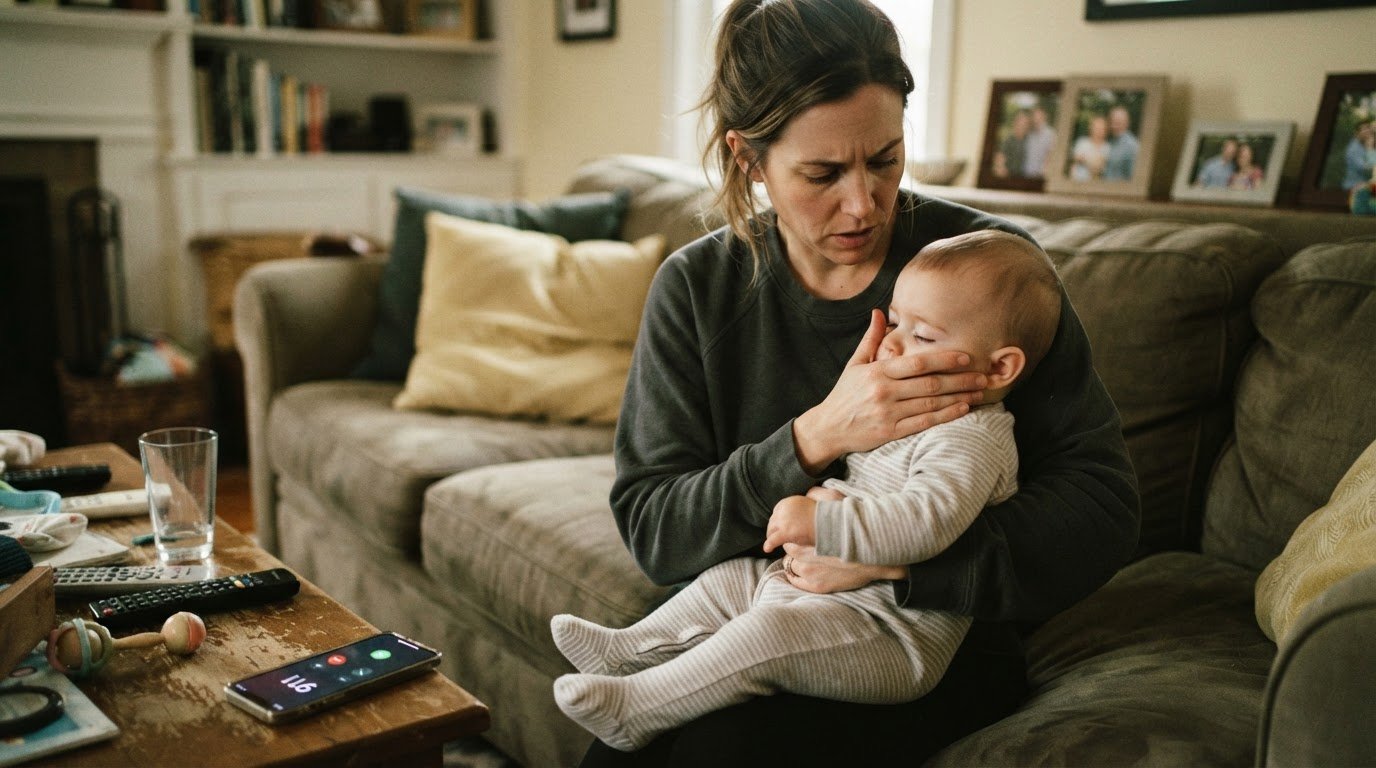
Baby Seizure Emergency: When to Call 911 and First Aid Steps
Baby Seizure Emergency: When to Call 911
You’re staring at your baby, and something in their body is moving in a way that doesn’t look right — stiffening, jerking, eyes rolling, maybe blue lips. This is a baby seizure emergency, and your hands are shaking. That’s okay. You’re doing the right thing by looking for help right now.
This article walks you through what a baby seizure actually looks like, when to call 911, what to do in the moment, and what happens after it stops. You’ll get a clear decision checklist, the differences between a febrile seizure and an epileptic seizure, and plain-language recovery-position steps. Every threshold is concrete — age, duration, symptom combos — so you can act instead of guess.
If your baby is seizing right now and it’s the first one, or it’s lasting more than 5 minutes, call 911 before you finish reading.
Looking for expert guidance on baby seizure emergency? This comprehensive guide covers everything you need to know, from understanding the basics to making informed decisions for your family.
What a Baby Seizure Actually Looks Like
A baby seizure can look very different from the Hollywood version — stiffening, jerking, eyes rolling, or just a brief blank stare with lip-smacking. Knowing what type you’re seeing helps you describe it to 911 or your pediatrician.
Tonic-clonic vs subtle vs febrile signs in infants
Tonic-clonic seizure baby — limbs stiffen then jerk rhythmically, eyes may roll up, breathing can sound odd, skin may turn bluish. Lasts 1–3 minutes usually.
Subtle/focal seizure — staring, eye fluttering, chewing motions, one arm jerking, pedaling legs. Easy to miss; often mistaken for fussiness.
Febrile seizure — triggered by fever, typically ages 6 months–5 years. Usually tonic-clonic, brief (<5 min), and happens as temperature rises quickly.
What to notice and tell the dispatcher:
- Which body parts are moving
- Eye position (rolling, fixed, closed)
- Skin color (blue, pale, flushed)
- Whether baby responds to your voice or touch
- Time it started and how long it’s lasted
If this is the first seizure, or it’s lasting more than 5 minutes, call 911 now — don’t finish reading.
This section provides general information, not a diagnosis. Infant seizure symptoms vary widely — a clinician must evaluate any seizure.
ChildBloom Medical Disclaimer: This content is for informational purposes only and does not replace professional medical advice, diagnosis, or treatment. Always seek the guidance of your child’s pediatrician or emergency services for concerning symptoms.
When to Call 911 for a Baby Seizure
Call 911 for any first-ever seizure, any seizure lasting over 5 minutes, or any seizure with trouble breathing, blue lips, or unresponsiveness. This is a baby seizure emergency — dialing first and reading second is the right move.
Age thresholds and red-flag symptoms
- Under 3 months: any seizure → call 911 now
- Any age: seizure longer than 5 minutes, repeated seizures without full recovery between, blue or pale skin, labored breathing, injury from fall, or baby doesn’t wake after stopping
- First seizure ever, even if brief, needs 911 or immediate ER evaluation
When to call 911 for seizures — quick checklist
- First-ever seizure, regardless of suspected cause
- Duration over 5 minutes (verify exact threshold with your clinician)
- Breathing difficulty or blue lips
- Unresponsive after seizure stops
- Injury, drowning, or head trauma before the event
- Multiple seizures in a row
Febrile seizures typically affect babies 6 months–5 years and are usually brief, but first-ever still needs emergency evaluation to rule out other causes. What to tell the dispatcher: which body parts are moving, eye position, skin color, whether baby responds, and start time.
This section provides general information, not a diagnosis. Infant seizure symptoms vary — a clinician must evaluate any seizure.
ChildBloom Medical Disclaimer: This content is for informational purposes only and does not replace professional medical advice, diagnosis, or treatment. Always seek the guidance of your child’s pediatrician or emergency services for concerning symptoms.
Baby Seizure First Aid — What to Do Right Now
Baby seizure first aid is simple: protect the airway, time the event, and don’t put anything in the mouth. Your job is safety and observation — not stopping the seizure.
Do:
- Lower baby to the floor or away from hard edges; clear space around the head.
- Turn baby onto their side (recovery position) once convulsions ease.
- Start a timer now — note when it began and how long it lasts.
- Note which body parts are moving, eye position, and skin color for the clinician.
Don’t:
- Restrain limbs or try to hold baby still — this risks injury.
- Put fingers, spoons, or anything in the mouth — baby won’t swallow the tongue.
- Give water, food, or any medication until fully alert.
If this is the first seizure, or it lasts over 5 minutes, call 911 while you’re protecting the baby (verify the exact threshold with your clinician). If baby turns blue, stops breathing, or is unresponsive after the seizure stops, call now — don’t wait.
Keep a note of the start time, what body parts moved, and how baby acts afterward. That info helps the clinician more than you think.
This is general guidance, not a diagnosis — a clinician must evaluate any seizure.
ChildBloom Medical Disclaimer: This content is for informational purposes only and does not replace professional medical advice, diagnosis, or treatment. Always seek the guidance of your child’s pediatrician or emergency services for concerning symptoms.
Febrile Seizure vs Epileptic Seizure — Key Differences
A febrile seizure is triggered by fever; an epileptic seizure is not fever-dependent and often recurs without illness.
Febrile seizure
- Typically ages 6 months–5 years (standard AAP/CDC range).
- Linked to a rapid temperature rise, often from a common infection.
- Usually tonic-clonic movements, lasting seconds to under 5 minutes.
- Most outgrow them; they don’t mean your child has epilepsy.
Epileptic seizure
- Can happen with or without fever.
- Recurs; diagnosis needs clinical evaluation and often EEG/imaging.
- Many types exist — some subtle (staring, rhythmic jerking) vs. full-body convulsions.
What matters in the moment: fever presence helps guess cause, but a first-ever seizure still gets the same emergency response regardless of temperature. Don’t try to sort the label while it’s happening — protect, time, call if indicated.
Afterward, share the fever pattern, seizure description, and baby’s age with your pediatrician. This distinction matters for follow-up, not for the immediate 911 decision.
Requires verification: exact febrile seizure age range and recurrence rates should be confirmed with your clinician against current AAP guidance.
ChildBloom Medical Disclaimer: This content is for informational purposes only and does not replace professional medical advice, diagnosis, or treatment. Always seek the guidance of your child’s pediatrician or emergency services for concerning symptoms.
How Long Is Too Long — Baby Seizure Duration
A seizure lasting more than 5 minutes is a medical emergency — call 911 immediately.
Most febrile seizures stop on their own within 1–2 minutes, though they can feel much longer than they are. Time from the moment you press start on your phone clock, not from when you first noticed the movement.
If the seizure keeps going:
- Note the time it started
- Place baby on their side (recovery position — see section below)
- Clear hard objects nearby
- Call 911 if it reaches 5 minutes, or sooner if breathing changes or skin turns blue
Requires verification: the 5-minute threshold for emergency intervention should be confirmed with your treating clinician against current AAP guidance — some protocols use 3–5 minutes depending on context.
ChildBloom Medical Disclaimer: This content is for informational purposes only and does not replace professional medical advice, diagnosis, or treatment. Always seek the guidance of your child’s pediatrician or emergency services for concerning symptoms.
Infant Recovery Position — Plain-Language How-To
The infant recovery position keeps your baby’s airway clear after jerking stops — on their side, supported so they can’t roll flat.
How to do it once the seizure ends:
- Gently roll baby onto their side, supporting the head and neck
- Bend the top knee forward so the body is stable and won’t roll onto the stomach
- Keep the face pointed slightly downward so saliva or fluid can drain, not block the airway
- Stay with baby and check breathing until they’re fully alert
For a newborn or small infant, hold them cradle-side on your forearm with the head tilted slightly down rather than laying them flat — their neck is too weak to hold safely on their own yet.
Do not put pillows, blankets, or anything under the head. Do not try to restrain limbs or put anything in the mouth once the active phase is over.
Requires verification: exact positioning details should be confirmed with your pediatrician or the seizure care plan from your treating clinician, especially for premature or low-tone infants.
When to call 911 instead of positioning: If baby isn’t breathing normally, turns blue, or doesn’t wake up after the jerking stops — start rescue breathing cues and call 911 immediately.
ChildBloom Medical Disclaimer: This content is for informational purposes only and does not replace professional medical advice, diagnosis, or treatment. Always seek the guidance of your child’s pediatrician or emergency services for concerning symptoms.
After the Seizure Stops — Post-Event Care & When to Follow Up
After a seizure, your baby will likely be limp, drowsy, or confused — this is the post-ictal phase, and it can last minutes to over an hour.
Should I wake my baby after a seizure?
- Check breathing first. If breathing is steady and baby is color-normal, let them sleep; wake them gently every 15–20 minutes to confirm responsiveness.
- If you can’t wake them, or breathing is irregular, call 911.
Immediate post-seizure steps:
- Place baby on their side in the recovery position once jerking stops.
- Don’t offer food, water, or medicine until fully alert.
- Loosen tight clothing; note how long the seizure lasted and what body parts moved.
Follow-up decision tree:
- First-ever seizure → ER, even if it stopped quickly.
- Known febrile seizure, baby back to baseline → call pediatrician same day.
- Repeated seizures, breathing trouble, blue skin, or no return to baseline → 911.
Data unavailable: no keyword-volume or traffic projections configured for this content.
ChildBloom Medical Disclaimer: This content is for informational purposes only and does not replace professional medical advice, diagnosis, or treatment. Always seek the guidance of your child’s pediatrician or emergency services for concerning symptoms.
Should I Take My Baby to the ER Even If the Seizure Stopped?
Yes — for most babies, a seizure that stopped is still a reason to get evaluated, especially if it was the first one.
Go to the ER or call 911 now if:
- Baby is under 12 months old
- This was the first seizure ever
- The seizure lasted more than 5 minutes
- Baby isn’t breathing normally, is blue, or can’t be woken
- Another seizure starts right away
You can call the pediatrician same day (not 911) if:
- Baby has a known febrile seizure history, stopped within a few minutes, and is back to their baseline
- The pediatrician has already given you a seizure action plan
Even if your baby seems completely fine afterward, the event needs a proper look — sometimes the cause isn’t obvious until a clinician checks vitals, blood sugar, or infection signs. Trust your gut: if something felt off, go in.
Data unavailable: no keyword-volume or traffic projections configured for this content.
ChildBloom Medical Disclaimer: This content is for informational purposes only and does not replace professional medical advice, diagnosis, or treatment. Always seek the guidance of your child’s pediatrician or emergency services for concerning symptoms.
The bottom line
Safe the baby, time the seizure, call 911 if any red-flag threshold is met. Any seizure in a baby under 3 months is an emergency call — don’t wait. Don’t restrain, don’t put anything in the mouth, don’t give medicine during the seizure. Most febrile seizures stop within 5 minutes but still need medical follow-up; note the details — duration, movements, fever — to share with your pediatrician. You’re doing the right thing by getting clear on this now. If you’re mid-event, your job is simple: protect, time, call. Everything else can wait until the seizure stops.
Data unavailable: no keyword-volume or traffic projections configured for this content.
ChildBloom Medical Disclaimer: This content is for informational purposes only and does not replace professional medical advice, diagnosis, or treatment. Always seek the guidance of your child’s pediatrician or emergency services for concerning symptoms.
Related Reading on ChildBloom
- Baby asthma attack emergency response
- Baby poison control number and first steps
- Baby ibuprofen dosing guide
References and Resources
Frequently asked questions
Can teething cause seizures in babies?
Teething alone does not cause seizures, but teething can raise a baby’s temperature slightly — and fever is the trigger for febrile seizures in some infants. If your baby has a seizure while teething, treat it as a seizure emergency and call 911 or your local emergency number rather than assuming it’s “just teething.”
What besides fever can trigger a seizure in a baby?
Common triggers include infections (ear, urinary tract, meningitis), electrolyte imbalances, head injury, and in rare cases underlying neurological conditions. Newborns and young infants can seize from metabolic or genetic causes that have nothing to do with fever. If there’s no fever with the seizure, or the trigger isn’t obvious, urgent medical evaluation is still required.
How common are febrile seizures?
Febrile seizures affect roughly 2–5% of children between 6 months and 5 years, peaking around 12–18 months — but any single episode still warrants the emergency response steps in this article. If your baby has a febrile seizure, count the duration, protect from injury, and call 911 if it lasts over 5 minutes or breathing is affected.
Will my baby remember the seizure?
Most infants do not remember a seizure — they may be confused, sleepy, or fussy afterward, but the event itself is not stored as a memory. What matters for recovery is how long the seizure lasted, whether breathing was normal, and whether a second seizure starts. Note the time, protect the airway, and follow the post-event care steps in the article.
Do I need to wake my baby after a seizure stops?
It’s normal for a baby to be deeply sleepy after a seizure — don’t force wakefulness, but do check breathing and responsiveness regularly. If your baby is hard to rouse, breathing is irregular, or another seizure starts, call 911 or go to the ER. When in doubt, treat it as a seizure emergency and seek same-day medical evaluation.
Should I give fever medicine after a seizure to prevent another one?
You can give the correct dose of acetaminophen or ibuprofen (if age-appropriate) for comfort, but fever medicine does not prevent febrile seizures and is not a substitute for medical evaluation. Never give aspirin to a child, and double-check dosing with your pediatrician if you’re unsure of weight or concentration. If another seizure starts before the medicine takes effect, call 911.
My baby had one brief seizure — do we need to see a pediatrician the same day?
Yes — even a short, single seizure needs same-day or urgent pediatric evaluation to check for infection, injury, or metabolic causes. Bring a video if you recorded it, note the duration and what happened before/after, and list any recent illness or head bumps. Go to the ER or call 911 immediately if the seizure lasted over 5 minutes, repeated, or breathing was abnormal.
This FAQ is general information, not a substitute for professional medical advice. If you’re unsure whether your baby’s situation is an emergency, call your pediatrician or 911 right away.